Research synthesis /2017–2026
What persists.
What becomes specific.
Memory movement, software compatibility, power and credible measurement recur. Later exchanges add detail about ownership, contention, recovery and AI serving.
Ten years of Q&A evidence
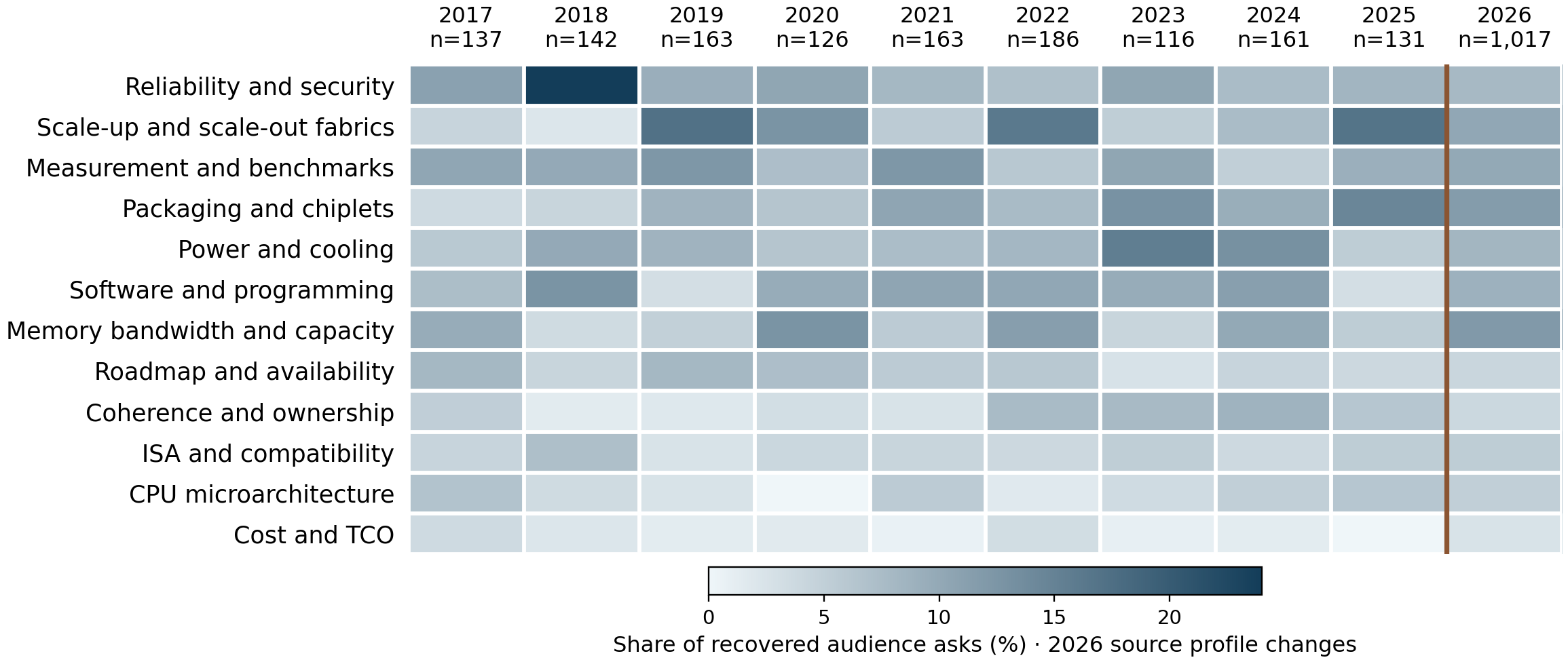
2017–2026 / descriptive comparisonDarker cells show a larger share of the reviewed audience asks in that year. The new 2017–2021 reviews use official YouTube captions;2026 retains the earlier mixed-source aggregate. Hover or focus a cell for its exact count and share.
| Theme | 2017n = 137 | 2018n = 142 | 2019n = 163 | 2020n = 126 | 2021n = 163 | 2022n = 186 | 2023n = 116 | 2024n = 161 | 2025n = 131 | 2026n = 1,017 · mixed source |
|---|---|---|---|---|---|---|---|---|---|---|
| Reliability and security | 15 / 137 (10.9%) | 34 / 142 (23.9%) | 15 / 163 (9.2%) | 13 / 126 (10.3%) | 13 / 163 (8.0%) | 13 / 186 (7.0%) | 12 / 116 (10.3%) | 12 / 161 (7.5%) | 11 / 131 (8.4%) | 80 / 1017 (7.9%) |
| Scale-up and scale-out fabrics | 6 / 137 (4.4%) | 3 / 142 (2.1%) | 28 / 163 (17.2%) | 16 / 126 (12.7%) | 9 / 163 (5.5%) | 30 / 186 (16.1%) | 6 / 116 (5.2%) | 12 / 161 (7.5%) | 22 / 131 (16.8%) | 103 / 1017 (10.1%) |
| Measurement and benchmarks | 14 / 137 (10.2%) | 14 / 142 (9.9%) | 20 / 163 (12.3%) | 9 / 126 (7.1%) | 20 / 163 (12.3%) | 11 / 186 (5.9%) | 12 / 116 (10.3%) | 8 / 161 (5.0%) | 12 / 131 (9.2%) | 102 / 1017 (10.0%) |
| Packaging and chiplets | 5 / 137 (3.6%) | 6 / 142 (4.2%) | 14 / 163 (8.6%) | 8 / 126 (6.3%) | 17 / 163 (10.4%) | 14 / 186 (7.5%) | 15 / 116 (12.9%) | 15 / 161 (9.3%) | 19 / 131 (14.5%) | 119 / 1017 (11.7%) |
| Power and cooling | 8 / 137 (5.8%) | 14 / 142 (9.9%) | 14 / 163 (8.6%) | 8 / 126 (6.3%) | 12 / 163 (7.4%) | 15 / 186 (8.1%) | 18 / 116 (15.5%) | 21 / 161 (13.0%) | 7 / 131 (5.3%) | 84 / 1017 (8.3%) |
| Software and programming | 10 / 137 (7.3%) | 18 / 142 (12.7%) | 5 / 163 (3.1%) | 12 / 126 (9.5%) | 17 / 163 (10.4%) | 19 / 186 (10.2%) | 11 / 116 (9.5%) | 18 / 161 (11.2%) | 4 / 131 (3.1%) | 90 / 1017 (8.8%) |
| Memory bandwidth and capacity | 13 / 137 (9.5%) | 5 / 142 (3.5%) | 8 / 163 (4.9%) | 16 / 126 (12.7%) | 9 / 163 (5.5%) | 21 / 186 (11.3%) | 5 / 116 (4.3%) | 16 / 161 (9.9%) | 7 / 131 (5.3%) | 122 / 1017 (12.0%) |
| Roadmap and availability | 11 / 137 (8.0%) | 6 / 142 (4.2%) | 13 / 163 (8.0%) | 9 / 126 (7.1%) | 9 / 163 (5.5%) | 11 / 186 (5.9%) | 3 / 116 (2.6%) | 7 / 161 (4.3%) | 5 / 131 (3.8%) | 42 / 1017 (4.1%) |
| Coherence and ownership | 7 / 137 (5.1%) | 2 / 142 (1.4%) | 3 / 163 (1.8%) | 4 / 126 (3.2%) | 4 / 163 (2.5%) | 14 / 186 (7.5%) | 9 / 116 (7.8%) | 14 / 161 (8.7%) | 8 / 131 (6.1%) | 40 / 1017 (3.9%) |
| ISA and compatibility | 6 / 137 (4.4%) | 10 / 142 (7.0%) | 4 / 163 (2.5%) | 5 / 126 (4.0%) | 7 / 163 (4.3%) | 7 / 186 (3.8%) | 6 / 116 (5.2%) | 6 / 161 (3.7%) | 7 / 131 (5.3%) | 54 / 1017 (5.3%) |
| CPU microarchitecture | 9 / 137 (6.6%) | 5 / 142 (3.5%) | 4 / 163 (2.5%) | 0 / 126 (0.0%) | 9 / 163 (5.5%) | 3 / 186 (1.6%) | 4 / 116 (3.4%) | 8 / 161 (5.0%) | 8 / 131 (6.1%) | 51 / 1017 (5.0%) |
| Cost and TCO | 5 / 137 (3.6%) | 3 / 142 (2.1%) | 2 / 163 (1.2%) | 2 / 126 (1.6%) | 1 / 163 (0.6%) | 6 / 186 (3.2%) | 1 / 116 (0.9%) | 2 / 161 (1.2%) | 0 / 131 (0.0%) | 25 / 1017 (2.5%) |
Counting rules and comparison limits
One independently answerable technical ask, one primary theme. Moderator prompts, unclear origins and unintelligible asks are excluded from the new historical heatmaps. Missing captions are absent evidence, never zero. Tutorials and keynotes are included in 2017–2021; later source populations and question opportunities differ. No new Slack content was accessed.
Share = primary-theme asks ÷ all eligible audience asks in that year. These twelve shared themes omit other primary families, so displayed shares do not sum to100%. Rows rank by mean within-year share, giving each year equal weight. Exact residual counts and source profiles appear in the data download. The2026 aggregate combines prior Slack and live-Q&A evidence; source changes and caption/attribution differences prevent a controlled industry time series.
Download exact ten-year data (CSV) · Ten-year Executive Brief · Full-resolution heatmap
The historical extension:2017–2021
Across ten conference years, the mechanisms changed while the qualification problems persisted: data placement, useful software, complete measurement and physical or security boundaries. The earlier recordings extend those concerns back before today's large serving systems; they do not prove a smooth shift in industry demand.
Data movement has a long history.
2017 serial-memory and reduction-locality questions precede 2019 embeddings, 2020 memory economics and 2022 placement/coherence discussions. Later memory and fabric scrutiny develops an existing system problem, rather than establishing a new one.
Software promises need operational proof.
2017 manual FPGA partitioning, 2018 mapping friction and 2019 compiler/format choices precede 2020 relocation and the later runtime questions. Portability repeatedly depends on exact operators, placement and synchronization.
Integration multiplies qualification gates.
2017 EMIB access/test questions and 2019 stacked-die uncertainty precede later chiplet, cooling and optical serviceability scrutiny. Denser integration changes power, repair and failure boundaries as well as bandwidth.
Trust boundaries remain architecture boundaries.
2018 speculative-state isolation and 2020 encryption gaps show why coherent addressing or a security block is insufficient. Later shared-memory and ownership questions still require explicit agent privileges, state transitions and recovery contracts.
Credible measurement is a recurring request.
VM and timing definitions in 2017, energy boundaries in 2018, mismatched algorithms in 2019 and simulated photonics in 2020 precede later system-power and bandwidth questions. Useful comparisons require consistent workloads and accounting boundaries.
Historical source: the new 2017–2021 official-recording Q&A briefs and timestamped ledgers. The following retained synthesis covers2022–2026 and its original evidence profiles.
The later five years:2022–2026
The latest independent 2022 assessment now goes beyond the programme. Reviewed presentations connect locality, node topology, coherence contracts, software placement and complete power accounting. Grace estimates and SmartNIC simulations also make measurement maturity a visible issue. These findings strengthen the continuity story: the later questions test operating details of concerns already present in 2022.
The updated 2022 assessment includes 251 caption-derived topical asks. The cross-year chart uses its audience-only subset of 186, mapped to common themes and normalized within the year. Question-boundary judgments, provisional caption attribution and coverage differences remain; the display is an exploratory comparison, not a controlled industry survey.
The 2023–2025 reviews use partial YouTube caption coverage; 2026 combines Slack with reported live Q&A. These sources do not support a clean industry-wide time series. Packaging remains prominent; cooling stands out in the reviewed 2023–2024 material, fabrics in 2025, and memory in 2026.
1. Credible measurement keeps recurring
The 2022 material already mixes pre-silicon estimates, simulations and measured examples. Its independent assessment calls for absolute results and explicit configuration and power boundaries before economic comparison.
In 2023, Intel was asked how much of a graph-compute system had actually been built. In 2025, Marvell clarified that a quoted latency excluded native DRAM access, while d-Matrix’s efficiency answer did not establish a wholecard boundary. In 2026, AMD distinguished a structural bandwidth maximum from workload bandwidth. Comparable measurement remains an unresolved procurement need.
2. Data placement becomes more explicit
In 2022, CXL separates pooling from coherent sharing, MI200 distinguishes node configurations, and NVLink Network uses explicit remote-address mapping. Those are different contracts for placement and ownership, not interchangeable forms of shared memory.
Qualcomm’s 2023 exchange addressed avoiding copies between compute engines. SK hynix’s 2024 discussion examined PIM interfaces and off-chip movement. Marvell’s 2025 answers bounded its coherence domain. In 2026, AMD distinguished node coherence from scale-up behaviour, while Samsung and XCENA described explicit host or software responsibilities. Shared addressing alone does not establish hardware cache coherence.
3. Software compatibility remains a delivery question
Groq, Tesla and Cerebras make placement and communication responsibilities visible in 2022; Arm’s MLIR material makes operator and quantization contracts explicit. Later runtime questions deepen an existing software obligation.
AMD was asked about ROCm coverage in 2023 and about runtime partitioning and context-switch overhead in separate 2024 sessions. The 2026 PIM and memory-compute answers still require software to manage some coherence transitions. include software support, synchronization and migration overhead in the system comparison.
4. Fabric scrutiny reaches operating behaviour
Tesla’s 2024 answers connected replay capacity to latency tolerance. NVIDIA’s 2025 exchange did not establish equivalent performance with mixed-vendor switches. A 2026 Broadcom question asked how programmable congestion policies prevent starvation or oscillation and remained open in Slack. Interoperability, predictable tails and recovery require separate evidence.
5. Physical feasibility includes maintenance
Tesla’s tile power and cooling, Lightmatter’s packaging and serviceability, and Ranovus’s engine-versus-laser power accounting put system boundaries into the 2022 evidence.
Fabric8Labs acknowledged unfinished lifetime testing in 2023. NVIDIA’s 2024 cooling discussion identified practical rack flow and manifold limits. Its 2025 optics answer covered replaceable external lasers but left the internal optical-engine repair procedure unresolved. qualify sustainable rack operation and the failed component’s service path before deployment.
6. Agentic AI adds a CPU workload question
Intel’s 2024 SMT answer already made efficiency workload-dependent. In 2026, IBM, NVIDIA and Arm sessions attracted questions about agentic workloads, host bottlenecks and CPU–GPU balance. NVIDIA attributed most of one claimed gain to IPC without a quantified decomposition. measure host demand before changing the fleet mix; these exchanges do not establish incremental CPU demand.
Serving has earlier precedents
The separate 2022 poster evidence includes KAIST DFX transformer generation and key/value buffering, and SK hynix GPT-3 inference with memory-side compute. This supports a historical precedent for serving concerns, not proof of economical present-day KV disaggregation.
Translate the patterns into acceptance tests
For head nodes, test clean shared data separately from dirty ownership, including peer-cache and valid DRAM supply under contention. For accelerators, compare matched prefill, decode and MoE runs with whole-server energy and host costs. For fabrics, test mixed traffic, incast and failures. For memory tiers, include transfer, flush, synchronization, reuse and recovery costs. For cooling and optics, qualify the failed component’s service path and sustainable rack conditions.
The architectural conclusion is a testing strategy: evaluate the CPU, accelerator, memory and network together against a serving workload and its latency target. The evidence does not select Venice over DMR, establish an MI400 advantage, or prove economical KV offload.
What each audience can do with this
Presenters and sell-side architects: state workload, measurement boundary, unsupported cases and open issues. Organisers: preserve links between online questions and spoken answers, and publish unresolved follow-ups. Buy-side architects and hyperscalers: turn repeated uncertainties into acceptance tests.
Implementors: budget for ownership, synchronization, recovery and repair. Investors and analysts: separate attention from adoption, revenue and investment returns; these questions do not establish incremental CPU demand. Attendees: follow a constraint across products instead of treating each talk as an isolated claim.
Sources and scope
Adapted from Hot Chips 2022 to 2026: Patterns and decisions for AI infrastructure, 27 September 2026, the later Hot Chips 2022 Independent Report, and the 2023–2026 annual executive briefs. Examples summarize their reviewed evidence; recommendations are editorial analysis. Private exchanges and raw attendee records are not reproduced.
2023 · 2024 · 2025 · 2026 · 2022 independent assessment