Hot Chips 30 /2018 / Official-recording Q&A
Deployment depends on boundaries.
Specialized hardware moved ahead of the system contracts needed to deploy it. Secure boundaries, usable software mapping and complete memory-and-power accounting became practical qualification gates.
Updated 2 October 2026 · Analyst interpretation of historical disclosures
Where audience questions concentrated
142 eligible audience asks across 13/13 caption-recovered recordings. Leading themes: reliability and security: 34 (23.9%); software and programming: 18 (12.7%); measurement and benchmarks: 14 (9.9%). Security spans speculative state, roots of trust and persistent memory. Server processors and the security session carry the largest recovered session totals.
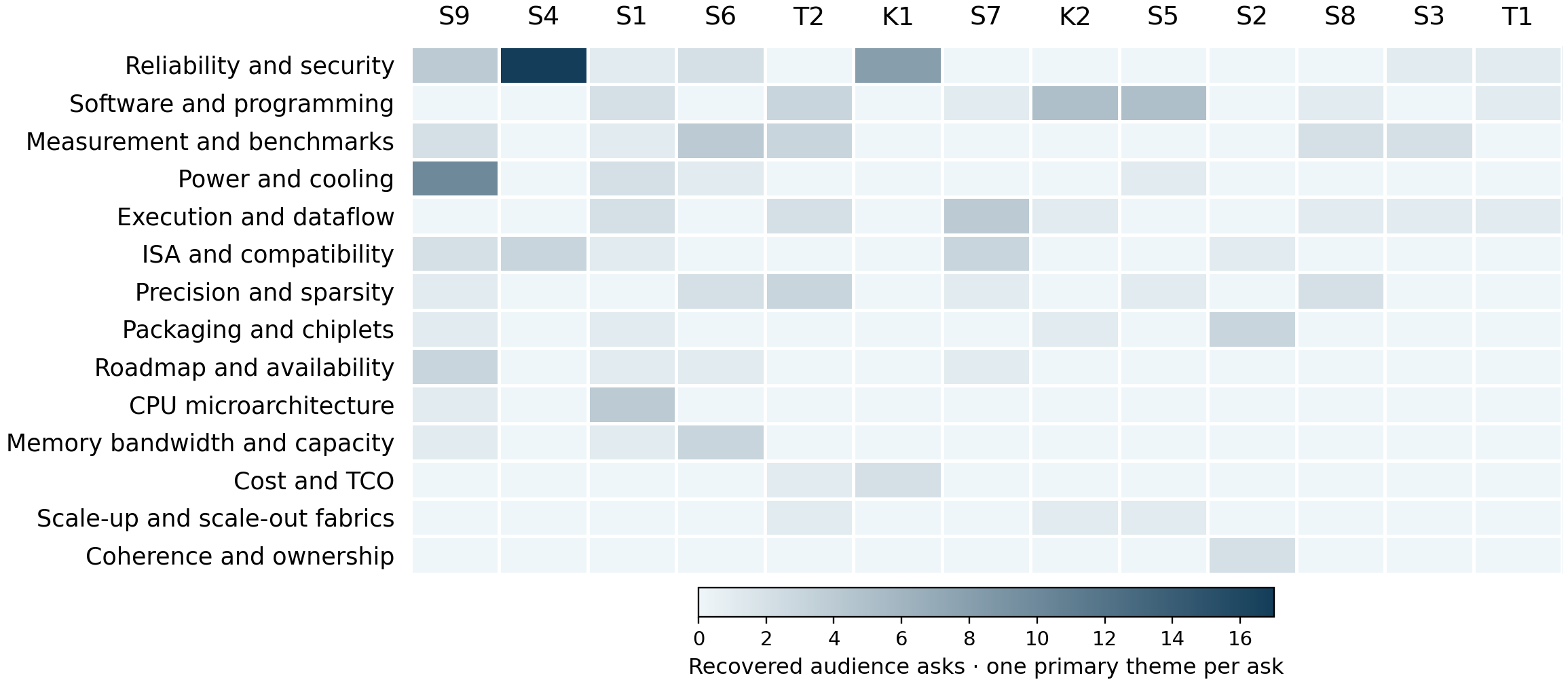
Darker cells mean more recovered asks on one raw-count scale. Both axes rank by marginal counts. Missing-caption sessions are hatched; available recordings with no eligible ask are true reviewed zeros. Q&A time is not normalized.
Counts, coverage and session key
Caption response status in the audience subset: partial 60; answered 64; deferred 14; unanswered 3; unclear 1. Unclear denotes missing or unintelligible caption evidence, rather than proof that no answer was spoken.
Reviewed timestamped automatic English captions, without independent audio verification. 170 audit rows; 28 excluded from the audience heatmap. Recorded origins: 144 audience, 12 moderator, 14 unknown. Unintelligible and out-of-scope asks are also excluded. One independently answerable technical ask has one primary theme; separate requested facts can count separately within an exchange.
T1 covers Mohan's segment; the later XRP program segment is absent from this recording. Caption omissions can hide questions and answers even in recovered recordings. Answer status describes what the vendor said, rather than independently verified truth. Attention is not market importance, adoption or investment merit. No Slack content was accessed.
- T1 Blockchains and Distributed Ledgers — official recording ↗
- T2 Architectures for Accelerating Deep Neural Nets — official recording ↗
- S1 Mobile/Power Efficient Processors — official recording ↗
- S2 Graphics Solutions — official recording ↗
- K1 Spectre/Meltdown — official recording ↗
- S3 IoT/Edge Computing — official recording ↗
- S4 Security — official recording ↗
- S5 Switching Fabrics and FPGA Architectures — official recording ↗
- S6 New Technologies — official recording ↗
- K2 Adaptable Intelligence: The Next Computing Era — official recording ↗
- S7 Machine Learning I — official recording ↗
- S8 Machine Learning II — official recording ↗
- S9 Server Processors — official recording ↗
Download exact session/theme counts (CSV) · Two-page Executive Brief
Patterns in the reviewed Q&A
Security needs an explicit contract.
The Spectre/Meltdown panel discussed protected execution subcontexts and shared accelerator state. Cascade Lake supplied no verification evidence for mitigation coverage. Titan narrowed the trusted surface without removing every CPU, software or foundry dependency. K1 88:26 ↗
Programmability shifts work into mapping.
Project Everest disclosed no autovectorizing compiler and deferred receive-programming details. Pixel Visual Core and dynamic-graph questions tested what developers still had to map and synchronize. Higher-level access did not prove transparent application portability. S5 90:37 ↗
Memory needs lifecycle accounting.
Mythic's intermediate activations occupied tile SRAM; A64FX had an HBM capacity ceiling. Optane answers withheld requested endurance and operating-state power figures. Density and bandwidth alone did not establish service lifetime or working-set fit. S9 123:48 ↗
Sparsity benefits differ by mechanism.
Arm said 3D convolution could be mapped without native support; DeePhi used structured sparsity. Mythic said zero weights would reduce current without increasing dense-matrix capacity. Energy, compute and capacity benefits required workload-specific evidence. S6 64:46 ↗
Efficiency claims need matching boundaries.
Samsung's power comparison was not fully process-normalized. XDNN described mapped compute rather than all FPGA resources. NRAM cell energy and Mythic whole-chip energy covered different budgets; their ratios could not be compared directly. S1 38:28 ↗
Implications and concrete vendor asks
Analyst inference: these present-day acceptance tests follow from historical uncertainties. Historical statements and roadmap promises do not establish later delivery.
| Decision and timing | Vendor ask and decision test |
|---|---|
| Shared-compute security Before deployment | Request protected-state and mitigation-validation coverage. Test cache, predictor and device-state leakage across hostile contexts; measure the cost of required isolation. |
| Application portability During proof of concept | Request compiler coverage, partitioning and synchronization rules. Port dynamic and unfamiliar operators; count manual work and fallback overhead at the service latency target. |
| Capacity and persistence Before platform commitment | Disclose SRAM limits, endurance, encryption location and idle/read/write power. Sweep working sets and sustained writes against the service lifetime and complete energy budget. |
| Numeric/operator fit Before accelerator selection | Specify native/mapped operators and which sparsity patterns save compute, energy or capacity. Test target shapes and precision settings at fixed model quality. |
| Comparative efficiency Before procurement ranking | Request matching baselines, process assumptions and resource occupancy. Reproduce useful throughput and energy including host, memory, interfaces and co-resident workloads. |
Sources and scope
Official Hot Chips 30 recordings, caption exports recovered2 October 2026. Source anchors link to the recorded exchanges. Patterns may use reviewed moderator or unattributed technical exchanges; plotted counts use the audience-only filter. The evidence ledger retains attribution, answer gaps and exclusion reasons.