Hot Chips 29 /2017 / Official-recording Q&A
Specialization needs a system contract.
Specialized compute and heterogeneous integration advanced faster than the disclosed contracts for programming, data placement, isolation and qualification. The useful architectural question was how the complete machine would behave under a real workload.
Updated 2 October 2026 · Analyst interpretation of historical disclosures
Where audience questions concentrated
137 eligible audience asks across 12/13 caption-recovered recordings. Leading themes: reliability and security: 15 (10.9%); measurement and benchmarks: 14 (10.2%); execution and dataflow: 14 (10.2%). Processor, FPGA and server exchanges contain much of the recovered technical scrutiny. Their time budgets and speaker counts differ, so this is attention within the reviewed evidence.
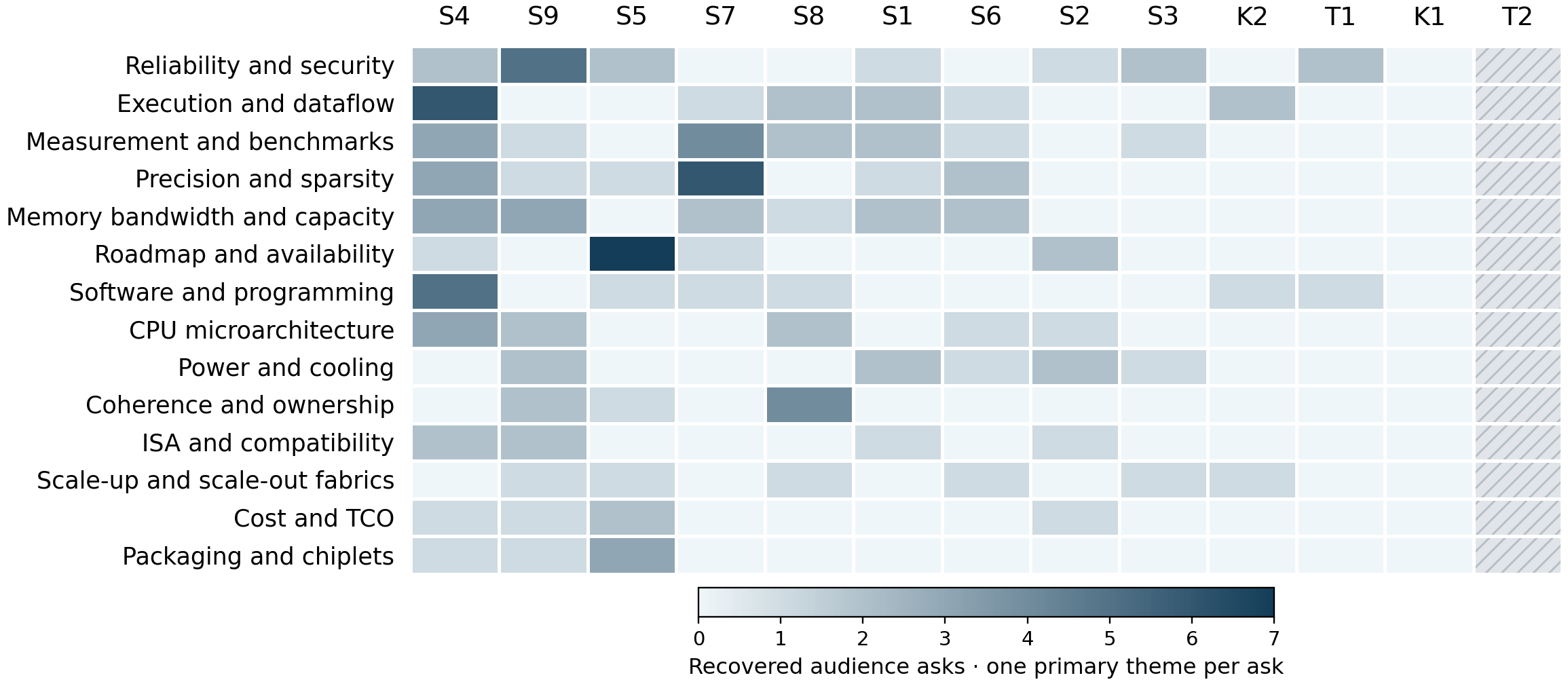
Darker cells mean more recovered asks on one raw-count scale. Both axes rank by marginal counts. Missing-caption sessions are hatched; available recordings with no eligible ask are true reviewed zeros. Q&A time is not normalized.
Counts, coverage and session key
Caption response status in the audience subset: answered 66; partial 57; deferred 7; unanswered 3; unclear 4. Unclear denotes missing or unintelligible caption evidence, rather than proof that no answer was spoken.
Reviewed timestamped automatic English captions, without independent audio verification. 165 audit rows; 28 excluded from the audience heatmap. Recorded origins: 145 audience, 4 moderator, 16 unknown. Unintelligible and out-of-scope asks are also excluded. One independently answerable technical ask has one primary theme; separate requested facts can count separately within an exchange.
Missing captions: T2. Caption omissions can hide questions and answers even in recovered recordings. Answer status describes what the vendor said, rather than independently verified truth. Attention is not market importance, adoption or investment merit. No Slack content was accessed.
- T1 P4 for Software Defined Networks: Language and Hardware Implementation — official recording ↗
- T2 Building Autonomous Vehicles with NVIDIA’s DRIVE Platform — official recording ↗ · missing transcript
- S1 GPU/Gaming — official recording ↗
- S2 IOT/Embedded — official recording ↗
- K1 The Direct Human/Machine Interface and Hints of a General Artificial Intelligence — official recording ↗
- S3 Automotive — official recording ↗
- S4 Processors — official recording ↗
- S5 FPGAs — official recording ↗
- S6 Neural Net I — official recording ↗
- K2 Machine Learning and the Implications for Computer System Design — official recording ↗
- S7 Neural Net II — official recording ↗
- S8 Architecture — official recording ↗
- S9 Server — official recording ↗
Download exact session/theme counts (CSV) · Two-page Executive Brief
Patterns in the reviewed Q&A
Programmability leaves isolation work.
P4 described trusted program control but deferred concurrent independent-program virtualization. Vega's guest ownership mechanism did not supply switching-latency figures. A programming interface alone did not establish predictable tenant sharing. T1 128:59 ↗
Locality shapes useful throughput.
Volta's tensor reduction depended on the kernel/framework and intermediate placement. Cisco's serial-attached memory traded capacity and connectivity against higher latency and I/O power. Peak arithmetic and link bandwidth hid different costs. S1 95:08 ↗
Packaging needs economic and test evidence.
EMIB questions probed access, cost and known-good-die assurance. EPYC's organic package prompted performance and die-yield questions. Integration feasibility did not settle supplier access, usable yield or the complete platform tradeoff. S5 62:41 ↗
Formats and software constrain specialization.
Brainwave questions pressed precision and accuracy assumptions. TPU exchanges examined workload size, sparsity and framework selection. AWS F1 required manual partitioning across FPGAs. Hardware specialization still demanded model and application work. S5 117:55 ↗
Timing figures need complete paths.
Arm defined L2 timing from address generation through the access path; system atomic details remained incomplete. EPYC's encryption answer discussed latency against coherence behavior. A cycle count or coherent address did not specify the whole transaction. S8 57:57 ↗
Implications and concrete vendor asks
Analyst inference: these present-day acceptance tests follow from historical uncertainties. Historical statements and roadmap promises do not establish later delivery.
| Decision and timing | Vendor ask and decision test |
|---|---|
| Shared programmable devices Before tenant deployment | Request state ownership, isolation and preemption contracts. Stress hostile co-tenants and measure switching tails, residual leakage and throughput under contention. |
| Memory and compute topology Before sizing | Measure dependent loads, intermediate traffic and useful throughput across local/remote paths. Accept capacity gains only when latency and energy targets hold. |
| Chiplet/package selection Before sourcing commitment | Request access terms, known-good-die coverage, yield assumptions and complete package cost. Test power delivery, repairability and the exact deployed configuration. |
| Accelerator software fit During proof of concept | Port target models at fixed quality. Count unsupported operators, partitioning effort and datatype conversions; measure whole-pipeline performance, including host work. |
| Shared-memory semantics Before interface freeze | Specify ownership transitions, stashing and atomic execution paths. Test contended producer/consumer transfers for correctness, traffic and tail latency. |
Sources and scope
Official Hot Chips 29 recordings, caption exports recovered2 October 2026. Source anchors link to the recorded exchanges. Patterns may use reviewed moderator or unattributed technical exchanges; plotted counts use the audience-only filter. The evidence ledger retains attribution, answer gaps and exclusion reasons.