Hot Chips 33 /2021 / Official-recording Q&A
Qualify the boundaries of specialization.
The recovered Q&A tests specialization at system boundaries: memory and ingestion, software portability, transport and ordering, numerical behavior and package power. These dependencies qualify useful compute; they do not establish that a particular architecture fails.
Updated 2 October 2026 · Analyst interpretation of historical disclosures
Where audience questions concentrated
163 eligible audience asks across 14/16 caption-recovered recordings. Leading themes: execution and dataflow: 29 (17.8%); measurement and benchmarks: 20 (12.3%); software and programming: 17 (10.4%). Infrastructure and data processors attract the most eligible asks. Caption response gaps are substantial: unclear status describes missing or unintelligible evidence, not proof of an unanswered question in the recording.
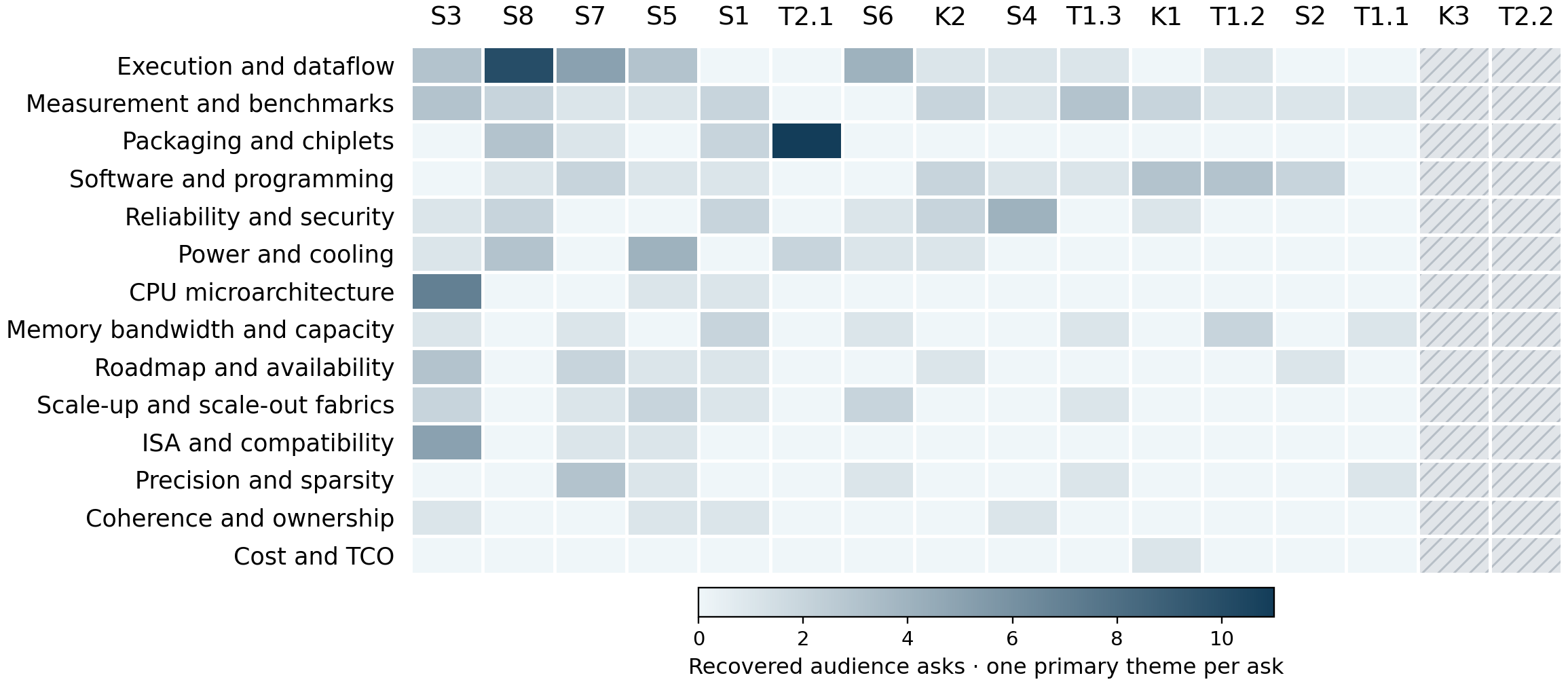
Darker cells mean more recovered asks on one raw-count scale. Both axes rank by marginal counts. Missing-caption sessions are hatched; available recordings with no eligible ask are true reviewed zeros. Q&A time is not normalized.
Counts, coverage and session key
Caption response status in the audience subset: answered 54; partial 38; unanswered 1; unclear 64; deflected 2; deferred 4. Unclear denotes missing or unintelligible caption evidence, rather than proof that no answer was spoken.
Reviewed timestamped automatic English captions, without independent audio verification. 246 audit rows; 83 excluded from the audience heatmap. Recorded origins: 170 audience, 24 moderator, 52 unknown. Unintelligible and out-of-scope asks are also excluded. One independently answerable technical ask has one primary theme; separate requested facts can count separately within an exchange.
Missing captions: K3, T2.2. Caption omissions can hide questions and answers even in recovered recordings. Answer status describes what the vendor said, rather than independently verified truth. Attention is not market importance, adoption or investment merit. No Slack content was accessed.
- S1 Server Processors — official recording ↗
- S2 Academic Spinout Chips — official recording ↗
- S3 Infrastructure and Data Processors — official recording ↗
- S4 Enabling Technologies — official recording ↗
- S5 ML Inference for the Cloud — official recording ↗
- S6 ML and Computation Platforms — official recording ↗
- S7 Graphics and Video — official recording ↗
- S8 New Technologies — official recording ↗
- K1 Does Artificial Intelligence Require Artificial Architects? — official recording ↗
- K2 Skydio Autonomy Engine: Enabling the Next Generation of Autonomous Flight — official recording ↗
- K3 Architectural Challenges: AI Chips, Decision Support, and High Performance Computing — official recording ↗ · missing transcript
- T1.1 Machine Learning Performance and Challenges, Part 1 — official recording ↗
- T1.2 Machine Learning Performance and Challenges, Part 2 — official recording ↗
- T1.3 Machine Learning Performance and Challenges, Part 3 — official recording ↗
- T2.1 Advanced Packaging, Part 1 — official recording ↗
- T2.2 Advanced Packaging, Part 2 — official recording ↗ · missing transcript
Download exact session/theme counts (CSV) · Two-page Executive Brief
Patterns in the reviewed Q&A
Feed the accelerator before judging arithmetic.
Samsung attributed the gap between PIM bandwidth uplift and application speedup to unchanged host and ordering overheads. Facebook emphasized ingestion benchmarking and reuse. Translation, DRAM-bank behavior and preprocessing still limited useful throughput. S4 88:51 ↗
The software path is part of the architecture.
Skydio described expensive architecture-specific optimization during porting. Alder Lake Linux-support questions survived without recoverable answers. Facebook's merged reads were client software. An engine or instruction did not establish a ready application path. K2 47:07 ↗
Transport and ordering define integration.
IBM described scoped ordering around Telum's accelerator; Enflame used noncoherent copies and mailboxes. Mount Evans' transport details were deferred. Compatibility, coherence and reliable transport were distinct properties requiring separate evidence. S1 97:29 ↗
Precision needs replay and quality evidence.
Graphcore described controlled seeds for stochastic-rounding replay. Xilinx distinguished BF16 from block floating point; Anton selected formats by pipeline stage. Efficiency depended on numerical behavior and workload quality rather than the format name alone. S6 29:24 ↗
Density and power need separate proof.
Intel discussed PowerVia with stacking and EMIB's yield/reach tradeoffs. Anton justified a global clock mesh through latency and power. TSMC cooling questions lacked useful caption answers; package scalability did not establish facility feasibility. T2.1 52:49 ↗
Implications and concrete vendor asks
Analyst inference: these present-day acceptance tests follow from historical uncertainties. Historical statements and roadmap promises do not establish later delivery.
| Decision and timing | Vendor ask and decision test |
|---|---|
| Specialized compute Before selection | Run matched end-to-end workloads including ingestion, host orchestration and storage. Measure utilization, tails and whole-system energy against a CPU baseline; profile the remaining bottleneck. |
| Software migration Before resource commitment | Request versioned compiler/runtime/kernel support and a reproducible port. Measure engineering effort, rejected operators and performance against the deployment schedule. |
| Accelerator/DPU integration Before host commitment | Specify coherence, ordering, transport and management separately. Test contended transfers, mixed hosts and recovery with versioned software and correctness checks. |
| Reduced precision Before model approval | Compare quality and convergence across formats and seeds. Verify deterministic replay; identify operations requiring higher precision and include their overhead. |
| Package and cooling Before platform commitment | Request design-kit access, process/yield evidence and steady/transient power. Test expected inlet temperature and flow, including facility energy and service limits. |
Sources and scope
Official Hot Chips 33 recordings, caption exports recovered2 October 2026. Source anchors link to the recorded exchanges. Patterns may use reviewed moderator or unattributed technical exchanges; plotted counts use the audience-only filter. The evidence ledger retains attribution, answer gaps and exclusion reasons.