Hot Chips 35 / 2023 / Recording Q&A
Software contracts meet physical systems
Software compatibility and validated system efficiency deserve as much weight as core and accelerator specifications.
Updated 2 October 2026 · Analyst interpretation of historical disclosures
Where audience questions concentrated
116 eligible audience asks in the reviewed caption material. FPGAs and cooling attracted the most questions in the reviewed material. Cooling volume was concentrated in the Fabric8 Labs exchange; software and measurement questions spread across more talks and affiliations.
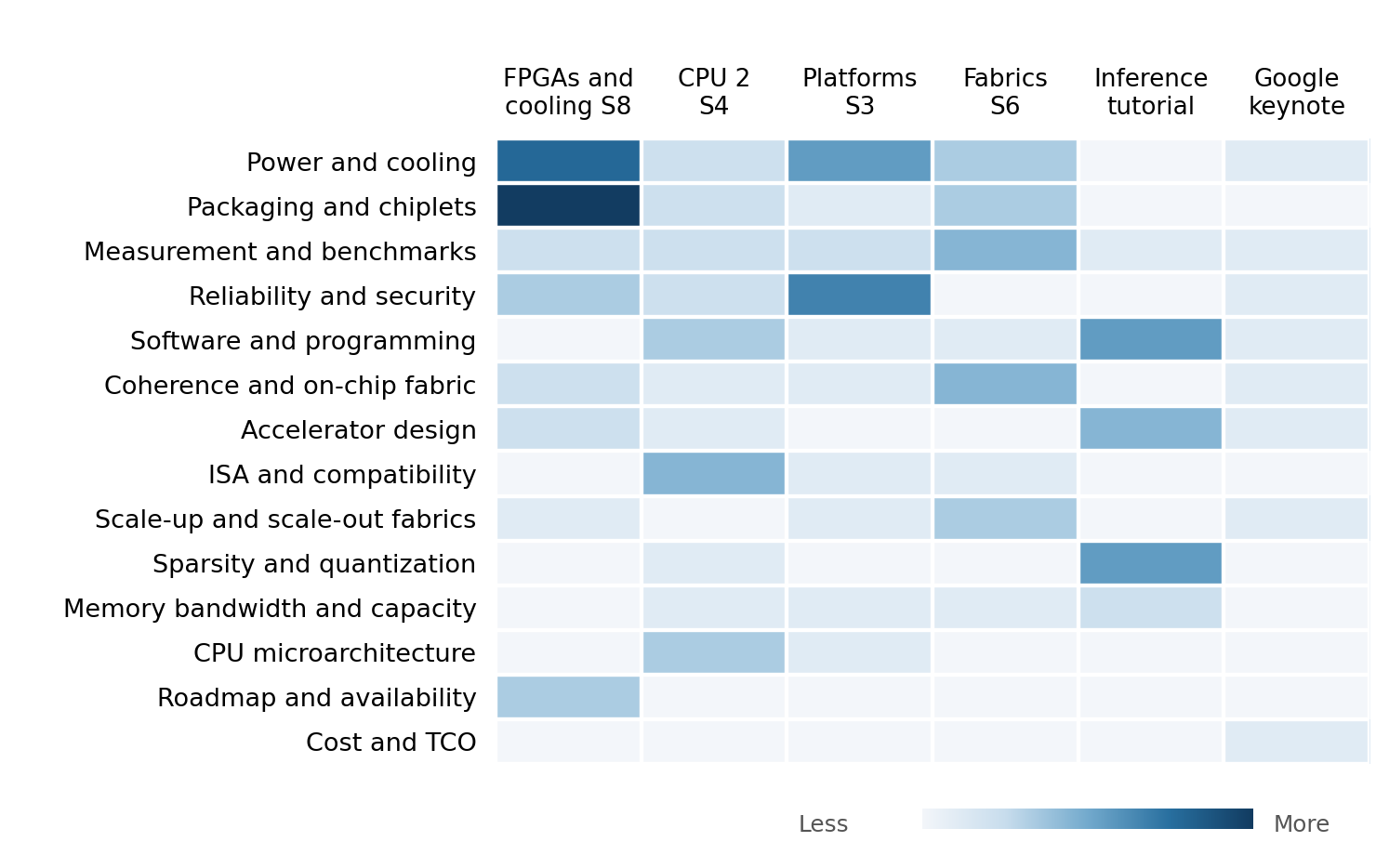
Original Executive Brief figure. Darker cells indicate more audience questions in reviewed session blocks; both axes run from hottest to coolest. Moderator prompts are excluded. Q&A time is not normalized.
Counts, coverage and session key
The figure is reproduced from the existing Executive Brief, without rebuilding its session matrix. Exact annual counts for the twelve common cross-year themes are available in the ten-year data; they do not cover the full annual taxonomy.
Conference coverage is partial. Moderator prompts are excluded from audience-question rankings. Caption errors and uneven session coverage limit comparisons; these counts describe reviewed evidence, not a complete conference census.
Based on the existing executive brief and its review of YouTube automatic captions. Conference coverage is partial; moderator prompts are excluded from audience-question rankings. Caption errors and uneven session coverage limit comparisons. Rankings describe the reviewed material, not the full audience or industry.
Two-page Executive Brief · Exact ten-year theme counts (CSV)
Patterns in the reviewed Q&A
Software compatibility is part of the architecture.
ROCm coverage, vector support and compiler responsibility drew questions across vendors. A hardware feature did not establish a usable software path.
Claims were tested against real workloads.
Questions asked what had been built and measured. Intel distinguished physical graph-compute testbeds from larger modeled configurations.
Packaging raised integration questions.
Chiplet arrangement, verification, materials and assembly all drew scrutiny. Physical integration answers were more concrete than future interoperability plans.
Cooling scrutiny included operational maturity.
Google described favorable operating experience. Fabric8 Labs said lifetime testing remained outstanding, despite promising thermal results.
Precision gains depended on model fit.
Questions tested sparsity structure, format choice and accuracy. Tutorial answers emphasized sensitivity and workload dependence.
Implications and concrete vendor asks
Analyst inference: these present-day acceptance tests follow from historical uncertainties. Historical statements and roadmap promises do not establish later delivery.
| Decision and timing | Vendor ask and decision test |
|---|---|
| Head nodes Before shortlist | AMD and Intel: provide Venice and DMR ISA, compiler, memory-topology and accelerator-I/O support matrices. Run identical host services under memory and I/O contention. Prefer the platform that preserves throughput and tail latency with less migration work. |
| MI400 Before prototype | AMD: demonstrate supported model paths, format accuracy, sparsity constraints and CPU–GPU handoff in the intended software release. Require sustained serving throughput at the same quality target; nominal compute alone cannot decide. |
| Scale-up and scale-out Before design freeze | Fabric suppliers: separate physical-system results from modeled scale. Supply topology, workload and failure-injection tests. Reconsider the topology if measured collectives or recovery erase its cost advantage. |
| KV-cache offload Before architecture lock | CPU, accelerator and memory suppliers: benchmark local memory versus peer or host-memory access using shared-prefix traces. Include copies, synchronization and contention. Offload wins only if useful capacity lowers serving cost within latency targets. |
| Cooling Before qualification | Server and cold-plate suppliers: provide lifetime, filtration, corrosion and maintenance results at the intended coolant conditions. Reject thermal-only comparisons that omit pumping power or service cost. |
Supporting architectural interpretation
Recurring themes within the reviewed questions and answers. The implications below are architectural interpretation, not a ranking of industry demand.
1. Usability is a recurring condition on hardware capability
ROCm coverage, vector support, compiler responsibility and precision sensitivity recur across the reviewed material.
Architectural implication: Evaluate supported workload paths and accuracy before valuing nominal compute or an ISA feature.
2. Integration maturity matters as much as the mechanism
Chiplet verification and assembly drew scrutiny, while cooling discussions distinguished operating experience from outstanding lifetime tests.
Architectural implication: Require qualification evidence for the complete assembly and service environment, alongside the architectural diagram.
3. Proof and popularity are separate signals
Questions challenged what was physically built versus modeled. Cooling volume concentrated in one exchange, while software and measurement concerns spread across more talks.
Architectural implication: Use repeated concerns to build tests; do not rank procurement importance solely by question volume.
These are present-day evaluation recommendations drawn from the historical evidence, rather than claims that later products were discussed in this conference year.
Software and model coverage
Require ISA, compiler and framework support matrices, format accuracy and sparsity constraints. Run supported model paths in the intended software release, including CPU–GPU handoff.
Measured scale
Separate physical-system results from modeled configurations. Test topology, collectives and recovery at the intended scale before extrapolating.
Memory and cooling economics
Include copies, synchronization and contention in offload tests. For cooling, require lifetime, filtration, corrosion, pumping-power and maintenance evidence at the intended coolant conditions.
Sources and scope
Based on the existing executive brief and its review of YouTube automatic captions. Conference coverage is partial; moderator prompts are excluded from audience-question rankings. Caption errors and uneven session coverage limit comparisons. Rankings describe the reviewed material, not the full audience or industry.
Research source: Hot Chips 2023 Executive Brief. Public edition omits raw question logs, private correspondence, personal attribution and attendee-only links.
Official Hot Chips 2023 site ↗ · Ten-year comparison →
Annual heatmap reproduced from Hot Chips 2023 Executive Brief. The format update preserves its source population and does not add new transcript or recording verification.