Hot Chips 38 / 2026 / Mixed-source Q&A
Evaluate the complete serving system
Evaluate CPU, accelerator, memory and fabric together. The reviewed evidence does not establish a Venice or Diamond Rapids winner.
Updated 2 October 2026 · Analyst interpretation of historical disclosures
Where audience questions concentrated
1,021 reviewed main-session questions; 1,017 audience questions in the ten-year comparison. Memory, packaging, interconnect and performance methodology were the largest primary themes in the integrated main-session question set. Attention identifies diligence needs; a less-discussed coherence or reliability gap can still block deployment.
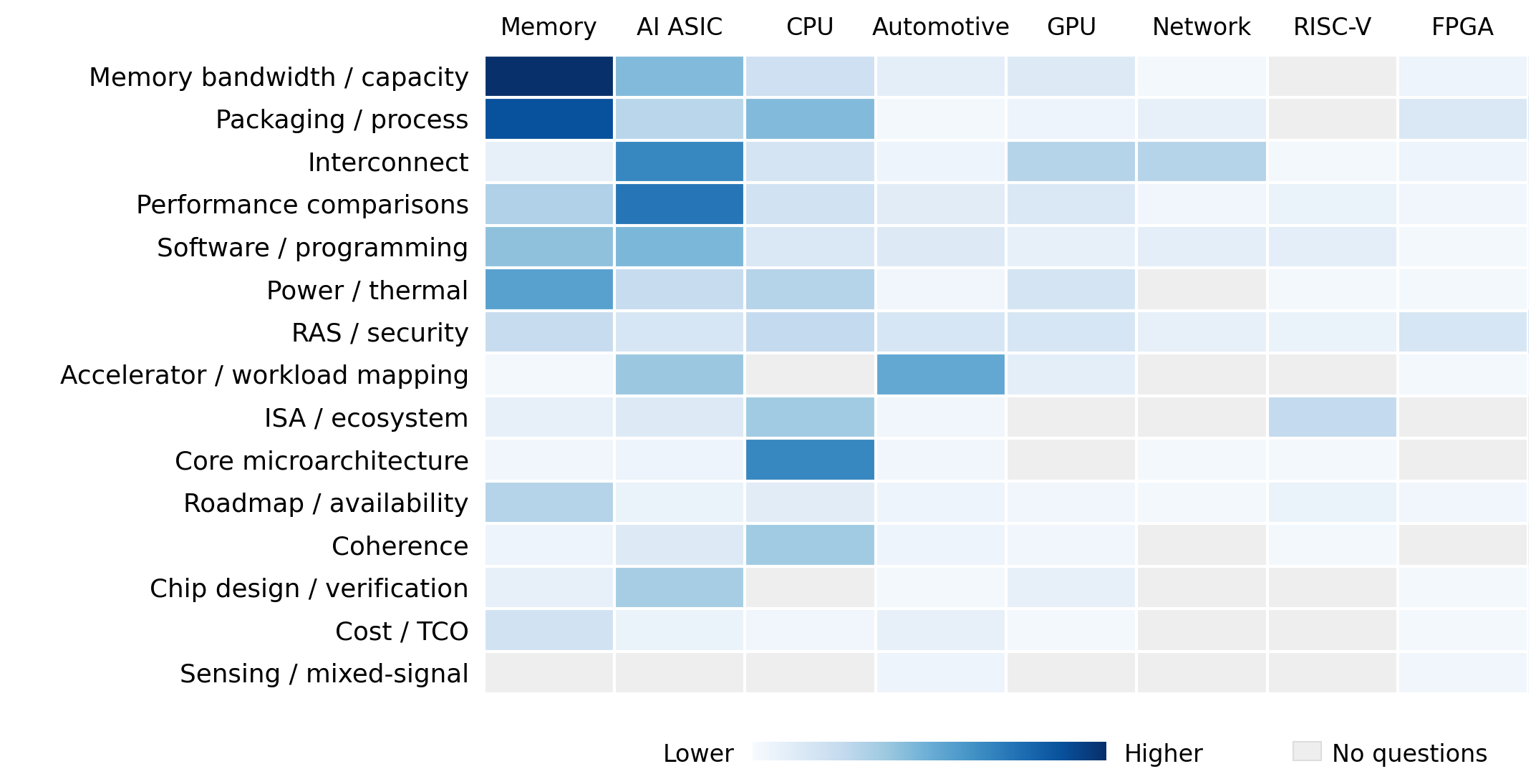
Original Executive Brief figure, with its own reviewed session categories. Darker blue indicates more coded questions; gray indicates no coded question in that figure. The final integrated totals below and the audience-only ten-year denominator have different scopes.
Counts, coverage and session key
The figure is reproduced from the existing Executive Brief, without rebuilding its session matrix. Exact annual counts for the twelve common cross-year themes are available in the ten-year data; they do not cover the full annual taxonomy.
The 1,021 main-session total includes four moderator prompts. The ten-year audience subset excludes them, giving 1,017. Main-session memory questions total 123; the audience-only memory count is 122. These denominators must not be interchanged.
Based on the existing executive brief and final integrated Slack & live-Q&A assessment, dated 26 September 2026. Slack is primary evidence; live findings are secondary evidence from a supplied analysis. No recording audio was independently reviewed. An unanswered question means no substantive answer was found in the reviewed sources, not deliberate vendor avoidance.
What the 2026 evidence actually covers
The integrated assessment preserves 950 original Slack rows and reconciles them to 925 canonical questions. It adds 115 distinct reported questions, giving 1,040 canonical questions across main sessions, posters and one DM-only question. Two possible overlaps remain outside the denominator.
| Reviewed main sessions | Questions |
|---|---|
| Fully answered | 325 |
| Partially answered | 217 |
| Open in reviewed evidence | 479 |
| Total | 1,021 |
These main-session figures exclude the 18 poster questions and one DM-only question. “Answered” describes coverage of the requested issue; it does not validate the vendor claim.
| Primary theme | Main-session questions |
|---|---|
| Memory | 123 |
| Packaging | 119 |
| Interconnect | 103 |
| Performance methodology | 102 |
Each question has one primary theme. The four rows are the leading themes, not the complete taxonomy. The main Slack cohort includes 204 askers and 119 stated affiliation labels; anonymous live questions do not add named participants.
What the live analysis changes
On the same 925-question baseline, reported live evidence moves fully answered questions from 224 (24.2%) to 271 (29.3%). It closes 48 prior gaps, makes 47 open questions partial, and downgrades one Meta answer after scope review. These changes are not independently audio-verified.
The original assessment lists twelve recordings totaling 21 hours 19 minutes 25 seconds, but independent audio review remains zero. Numerical live disclosures should therefore be treated as validation leads. DMR data-source selection, Vera coherence details and HBM4 economics remain priority follow-ups.
Two-page Executive Brief · Exact ten-year theme counts (CSV)
Patterns in the reviewed Q&A
Comparable performance.
Participants challenged precision, workloads and measurement boundaries, not just headline speedups.
Fabric behavior.
Routing, shared bandwidth and recovery mattered alongside aggregate link rates.
Memory movement.
Capacity questions also probed spill, migration and KV placement costs.
Software control.
Framework support did not settle porting effort or placement control.
Coherence boundaries.
Protocol names left ownership and data-return paths unresolved.
SMT trade-offs.
Threading rationales still needed workload-specific isolation and utilization comparisons.
Implications and concrete vendor asks
Analyst inference: these present-day acceptance tests follow from historical uncertainties. Historical statements and roadmap promises do not establish later delivery.
| Decision and timing | Vendor ask and decision test |
|---|---|
| AMD and Intel before head node selection | Ask: Explain cache ownership and when data comes from a peer cache or memory. Compare producer–consumer latency, useful bandwidth and CPU overhead while GPU and NIC traffic run concurrently. Provide counters to diagnose the results. Decision test: Choose the platform that meets latency, bandwidth and reliability requirements under concurrency. |
| AMD before committing to MI400 | Ask: Run agreed prefill, decode and MoE workloads with matched model, precision, context, batch and software. Report throughput, tail latency, energy per token, memory and link traffic, host utilization, system price and availability. Decision test: Commit when measured performance and cost meet the service target. |
| Fabric suppliers before procurement | Ask: Document coherence, ordering and interoperability guarantees. Test all-to-all and small-message collectives at the intended scale, with competing traffic, congestion and failures. Decision test: Require useful bandwidth and tail latency to hold under contention and after failures. |
| Memory and offload suppliers before KV partitioning | Ask: Explain KV ownership, cache maintenance and migration. Compare offload against keeping KV in HBM at the same accuracy and service target. Report bytes moved, write intensity, tail latency, recovery behavior, endurance and delivered cost per usable capacity. Decision test: Offload only when the measured capacity benefit exceeds the added system cost without breaking the service target. |
Supporting architectural interpretation
Recurring themes within the reviewed questions and answers. The implications below are architectural interpretation, not a ranking of industry demand.
1. The serving workload becomes the common evaluation unit
Performance-methodology, memory-movement and host-balance questions connect accelerator results to precision, context, placement and CPU work.
Architectural implication: Measure matched prefill, decode and MoE with host, NIC and energy costs included; component disclosures alone do not settle cost per token.
2. Capacity and connectivity do not settle ownership
Questions about spill and migration sit alongside unresolved coherence and data-return paths. Protocol names alone did not establish source selection or software obligations.
Architectural implication: Specify who owns KV and shared data, who may cache it, and what migration or cache maintenance costs under concurrency.
3. Operating conditions matter beyond advertised scale
Fabric questions probe routing, shared bandwidth and recovery; SMT questions require workload-specific utilization and isolation comparisons.
Architectural implication: Test useful bandwidth, tail latency and CPU service under competing traffic and failures at the intended scale.
4. Missing answers need evidence reconciliation
Reported live evidence changes some Slack-only answer classifications, but no recording audio was independently reviewed. Open questions are not proof of deliberate avoidance.
Architectural implication: Track unresolved conditions precisely and verify consequential numerical disclosures before relying on them.
These are present-day evaluation recommendations drawn from the historical evidence, rather than claims that later products were discussed in this conference year.
CPU head-node selection
AMD and Intel: explain cache ownership and peer-cache versus memory sourcing. Compare producer–consumer latency, useful bandwidth and CPU overhead during concurrent GPU and NIC traffic. Provide diagnostic counters.
MI400 evaluation
AMD: run matched prefill, decode and MoE workloads with the same model quality, precision, context, batch and software. Report throughput, tail latency, energy per token, memory and link traffic, host utilization, system price and availability.
Fabric procurement
Document coherence, ordering and interoperability guarantees. Test all-to-all and small-message collectives at the intended scale under competing traffic, congestion and failure.
KV placement
Explain ownership, cache maintenance and migration. Compare offload with HBM residency at the same quality and service target, including bytes moved, writes, tail latency, recovery, endurance and cost per usable capacity.
Sources and scope
Based on the existing executive brief and final integrated Slack & live-Q&A assessment, dated 26 September 2026. Slack is primary evidence; live findings are secondary evidence from a supplied analysis. No recording audio was independently reviewed. An unanswered question means no substantive answer was found in the reviewed sources, not deliberate vendor avoidance.
Research source: Hot Chips 2026 Executive Brief; Hot Chips 2026 — Integrated Slack & Live Q&A Assessment, final available-evidence edition. Public edition omits raw question logs, private correspondence, personal attribution and attendee-only links.
Official Hot Chips 2026 site ↗ · Ten-year comparison →
Annual heatmap reproduced from Hot Chips 2026 Executive Brief. The format update preserves its source population and does not add new transcript or recording verification.