Hot Chips 31 /2019 / Official-recording Q&A
Accelerators become system choices.
Accelerator differentiation was becoming a system problem. Memory placement, fabric behavior and the software contract repeatedly qualified arithmetic throughput, while recorded questions pressed architectural ambitions toward implementable interfaces and workload evidence.
Updated 2 October 2026 · Analyst interpretation of historical disclosures
Where audience questions concentrated
163 eligible audience asks across 13/13 caption-recovered recordings. Leading themes: scale-up and scale-out fabrics: 28 (17.2%); execution and dataflow: 23 (14.1%); measurement and benchmarks: 20 (12.3%). Tutorials contribute a substantial share of the recovered asks. Their longer question opportunities, conservative attribution and differing subject matter affect the annual distribution.
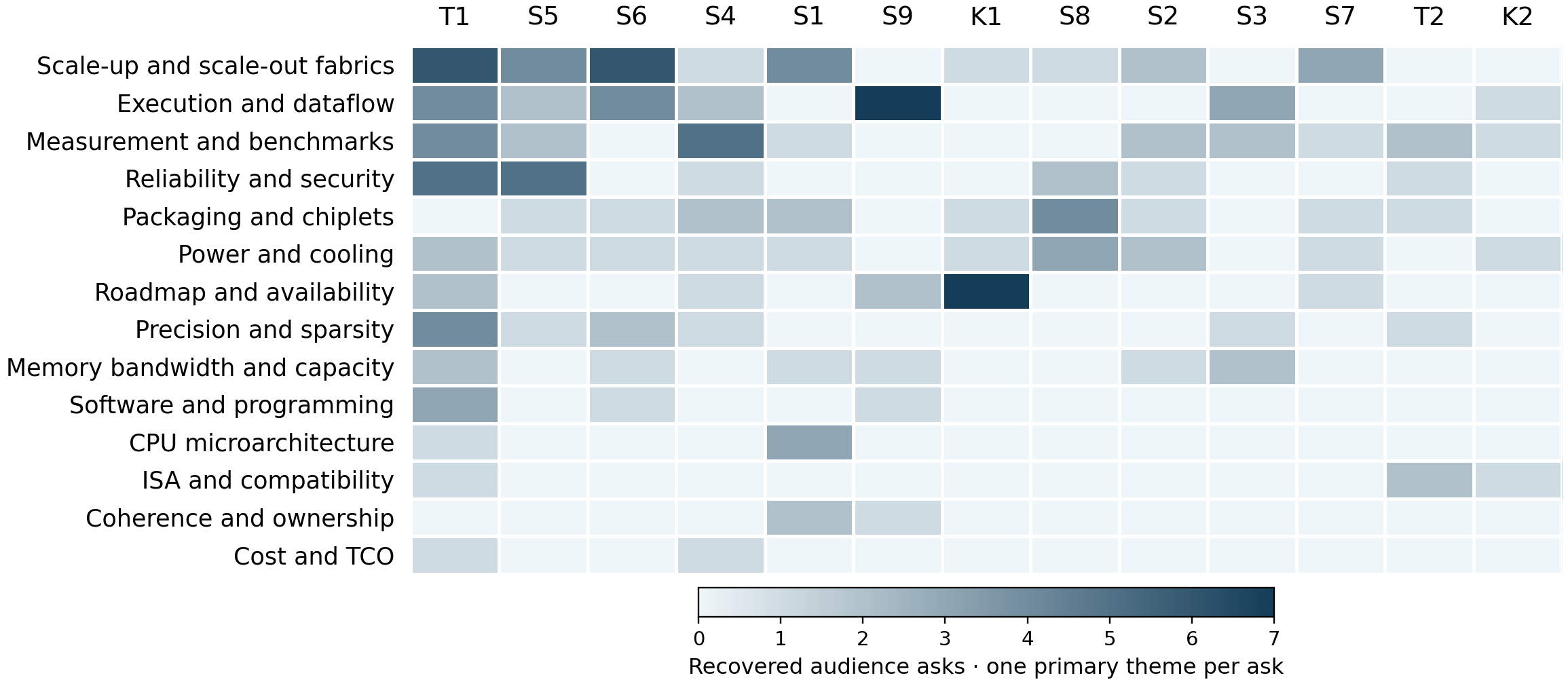
Darker cells mean more recovered asks on one raw-count scale. Both axes rank by marginal counts. Missing-caption sessions are hatched; available recordings with no eligible ask are true reviewed zeros. Q&A time is not normalized.
Counts, coverage and session key
Caption response status in the audience subset: partial 65; deflected 7; answered 75; deferred 9; unanswered 7. Unclear denotes missing or unintelligible caption evidence, rather than proof that no answer was spoken.
Reviewed timestamped automatic English captions, without independent audio verification. 211 audit rows; 48 excluded from the audience heatmap. Recorded origins: 163 audience, 4 moderator, 44 unknown. Unintelligible and out-of-scope asks are also excluded. One independently answerable technical ask has one primary theme; separate requested facts can count separately within an exchange.
Caption omissions can hide questions and answers even in recovered recordings. Answer status describes what the vendor said, rather than independently verified truth. Attention is not market importance, adoption or investment merit. No Slack content was accessed.
- K1 AMD keynote — official recording ↗
- K2 TSMC keynote — official recording ↗
- S1 General Purpose Compute — official recording ↗
- S2 Memory — official recording ↗
- S3 Methodology and ML Systems — official recording ↗
- S4 ML Training — official recording ↗
- S5 Embedded and Auto — official recording ↗
- S6 ML Inference — official recording ↗
- S7 Interconnects — official recording ↗
- S8 Packaging and Security — official recording ↗
- S9 Graphics and AR — official recording ↗
- T1 Acceleration in the Cloud — official recording ↗
- T2 RISC-V — official recording ↗
Download exact session/theme counts (CSV) · Two-page Executive Brief
Patterns in the reviewed Q&A
Interconnect names leave mechanisms unresolved.
Arm's cache stashing needed software and interface prerequisites; Xilinx qualified its nonblocking-mesh claim through traffic-class isolation. AWS discussed placement groups and packet-aware limiting. Topology and peak link rate did not describe congestion behavior. S1 66:07 ↗
Peak compute needs workload evidence.
Huawei and Spring Crest faced benchmark and MLPerf questions. Cerebras deferred working-system performance. Microsoft's compression comparison used different algorithms. Those answers exposed comparison boundaries that peak throughput alone could not resolve. S4 30:23 ↗
Sparse workloads make placement decisive.
Facebook described profile-guided embedding partitioning, local bandwidth versus distributed latency, and prefetch overfetch. UPMEM DPUs communicated through the CPU. Irregular accesses and host work belonged in accelerator sizing alongside dense kernels. S2 25:52 ↗
Numerical formats carry software obligations.
Intel linked its Flexpoint-to-BF16 change to software scaling. Google's BF16 and array-size answers described tested models and compiler co-design. Datatype support alone did not establish convergence, rounding behavior or utilization on real tensor shapes. S4 61:07 ↗
Integration adds power, test and trust gates.
Lakefield described known-good-die testing but left stacking limits unquantified. Tesla's dual-SoC safety intent did not specify disagreement handling. Jintide's monitor answer did not establish a complete host trust boundary. S8 26:47 ↗
Implications and concrete vendor asks
Analyst inference: these present-day acceptance tests follow from historical uncertainties. Historical statements and roadmap promises do not establish later delivery.
| Decision and timing | Vendor ask and decision test |
|---|---|
| Fabric/interface commitment Before topology selection | Specify ordering, traffic isolation, stashing prerequisites and forward progress. Test mixed traffic, congestion and recovery at the workload's tail-latency target. |
| Accelerator sizing Before using scaling graphs | Require reproducible matched algorithms, precision, batch and quality. Measure host, memory and network utilization with useful end-to-end throughput. |
| Sparse memory/CPU balance Before deployment | Sweep embedding size, skew, locality and profile drift. Include ingestion and updates; measure prefetch overfetch, latency and effective bandwidth. |
| Datatype/compiler contract Before model commitment | Verify convergence, rounding and overflow at fixed quality. Profile tensor shapes and schedules; include rejected operators and porting cost in acceptance. |
| Integrated platform readiness Before sign-off | Request stack power, thermal headroom, die-test coverage and fault handling. Inject failures and disagreement; verify monitor privileges and service recovery. |
Sources and scope
Official Hot Chips 31 recordings, caption exports recovered2 October 2026. Source anchors link to the recorded exchanges. Patterns may use reviewed moderator or unattributed technical exchanges; plotted counts use the audience-only filter. The evidence ledger retains attribution, answer gaps and exclusion reasons.